The ebook versus audiobook question often gets framed as a contest. It isn't. They suit different moments, different books and different people. This guide compares them honestly on cost, time, comprehension and convenience, so you can choose book by book.
Ebooks vs audiobooks at a glance
| Ebooks | Audiobooks | |
|---|---|---|
| Typical price | Usually lower | Usually higher (costly to produce) |
| Hands and eyes | Needed | Free for other tasks |
| Speed | Your own pace; skim or slow down | Set by narration (adjustable in most apps) |
| Highlighting and notes | Easy | Bookmarks and clips, less precise |
| Looking things up | Search inside the book | Harder |
| Tables, charts, maps | Visible | Often in a separate PDF, if at all |
| Performance | Your imagination | A narrator's voice and pacing |
Cost
Bought one at a time, ebooks are usually cheaper than audiobooks, because an audiobook needs a narrator, studio time and editing. Audiobook subscriptions can bring the cost per book down if you listen a lot, and library apps lend both formats free with a library card. For ebooks, daily deals and series bundles make the cost per book lower still. See how to find ebook deals.
Time: where each fits in your day
| Moment | Better format |
|---|---|
| Driving | Audiobook |
| Walking, running, gym | Audiobook |
| Housework, cooking, gardening | Audiobook |
| Train or bus | Either |
| Lunch break at a desk | Ebook |
| Evening in a chair or in bed | Ebook (or print) |
| Waiting rooms and queues | Ebook on your phone |
The real advantage of audiobooks is that they add reading time to parts of the day when reading text is impossible. The advantage of ebooks is that the book is always in your pocket, ready for the five minutes you didn't expect.
Comprehension and memory
People differ, and so do books. Text gives you control: you can slow down, re-read a sentence, glance back a page, and highlight what matters, which helps with detailed or technical material. Listening carries you along at the narrator's pace, which suits stories and ideas you absorb over time, but it's harder to go back to one precise sentence. If you want to remember a non-fiction book, reading it (or reading after listening) and keeping highlights usually helps. See highlights and notes.
How long a book takes
Reading speed varies a lot, but many adults read comfortably at somewhere around 200 to 300 words a minute. Audiobook narration is usually slower, often somewhere around 150 words a minute, though most apps let you speed it up. So a typical novel often takes a few hours longer to listen to than to read at your own pace, unless you listen faster. That matters less than it sounds: the hours you listen are often hours you couldn't have spent reading anyway.
| An 80,000-word book | Rough time |
|---|---|
| Reading at 250 words a minute | About 5 hours 20 minutes |
| Listening at about 150 words a minute | About 9 hours |
| Listening at 1.5x speed | About 6 hours |
Illustrative figures; your own speeds and the narrator's pace will differ.
Focus and attention
Listening while doing something else is convenient, but your attention is shared. With a gripping story that's rarely a problem; with a dense argument, it's easy to drift and miss a key point. Ebooks demand your eyes, which can make them better for books that need focus, and harder to fit into a busy day. A simple rule many readers use: light books by ear, heavy books by eye.
Families and children
Audiobooks are wonderful for car journeys and bedtime, when a whole family can share a story. For children learning to read, following text on a page or screen builds reading skills that listening alone doesn't. Many families use both: an audiobook in the car, a book at bedtime, and ebooks with large text for new readers.
Screens, sleep and eye comfort
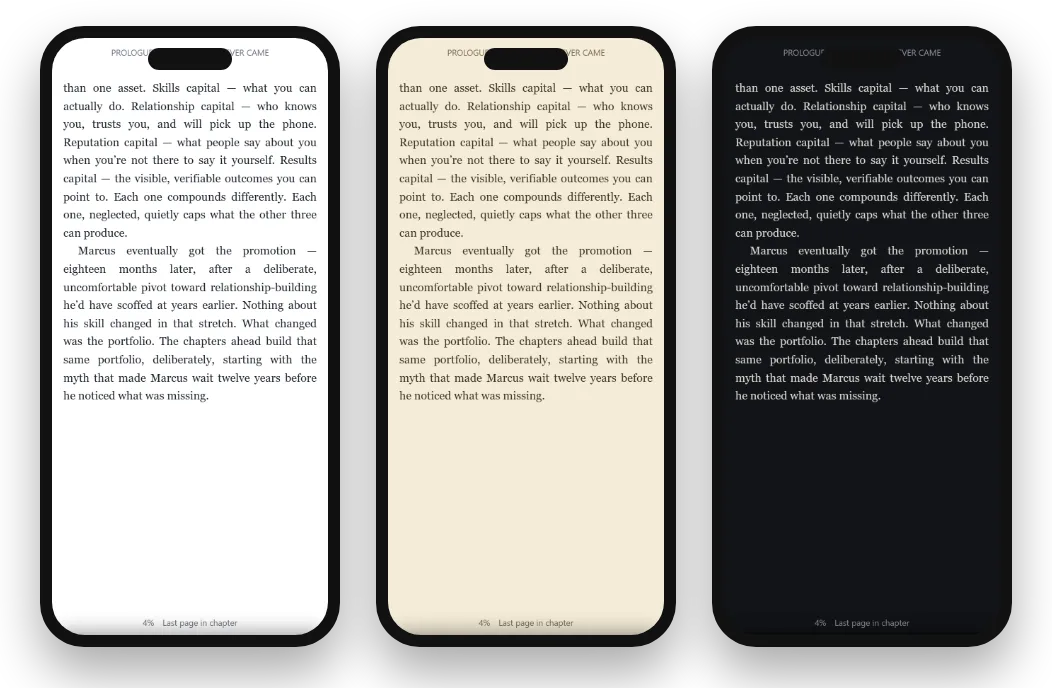
If you read ebooks in the evening, a warm Sepia or Dark theme, a comfortable text size and your device's night mode make a real difference to comfort. Some people prefer to wind down with an audiobook and the screen off; others find a gentle ebook the best way to end the day. Choose what helps you rest. More in reading ebooks on your phone comfortably.
Building a reading habit with both
- Map your week.Note the times your hands are busy and the times you could read.
- Match formats to moments.Audio for the busy times, text for the quiet ones.
- Keep one book of each on the go.A story to listen to and a book to read.
- Track what you finish, not the format, and notice what you enjoy most.
Which books suit which format
| Book type | Often better as | Why |
|---|---|---|
| Memoir read by the author | Audiobook | Hearing the author's own voice adds a lot |
| Narrative history | Either | A good story in either form; ebooks show maps and dates |
| Fiction | Either | Depends on the narrator and your preference |
| Business and self-help | Ebook for keepers | Easier to highlight and return to |
| Devotionals | Ebook or print | Daily reading, reflection and Scripture references |
| Reference and workbooks | Ebook or print | Tables, exercises and looking things up |
| Poetry | Both | Poems reward being heard and being seen on the page |
Storage, devices and ownership
Ebooks are small files or stream within a reading app, so hundreds fit on a phone with room to spare. Audiobooks are much larger and use more storage when downloaded. Both are usually tied to the store or app you bought them from, so it's worth choosing stores whose apps work on all the devices you use. Many readers keep one app for listening and one for reading, and find that simpler than looking for a single app that does everything.
Accessibility
Both formats open books to more people. Audiobooks help readers with dyslexia, low vision or fatigue. Ebooks help too: adjustable text size, fonts, line spacing and themes such as Sepia or Dark make reading comfortable for many readers who struggle with print. Many devices can also read ebook text aloud. Try both and use whichever is easiest for you.
Combining ebooks and audiobooks
- Listen on the move, read at home: some readers own both editions of books they love.
- Listen first, read to review: hear a non-fiction book on a commute, then read and highlight the chapters that mattered.
- Stories by ear, study by eye: fiction as audio, practical books as ebooks.
- Borrow audio, buy text: use a library app for audiobooks and buy the ebooks you want to keep.
A year of reading, two ways
Suppose you want to get through two books a month. A realistic mix for a busy person might be one book by ear during commutes and chores, and one ebook in the evenings. That doubles what you'd finish with a single format, without finding any extra time. The point isn't which format wins; it's that together they fit reading into more of your life.
Choosing for a particular book
- Will you want to look things up or quote it?Choose the ebook.
- Is there a great narrator, or is the author reading?Consider the audiobook.
- Does it have maps, charts or exercises?Choose the ebook or print.
- When will you actually get to it?If only on the move, the audiobook.
- Is price the deciding factor?The ebook is usually cheaper, especially on sale.
Where BooksOasis fits
BooksOasis is an independent bookstore for ebooks, paperbacks and hardcovers. It doesn't sell audiobooks. Its ebooks open in Oasis Reader in any browser on your phone, tablet or computer, with themes, adjustable text, highlights and notes that follow you between devices.
What BooksOasis does not do
- It doesn't sell audiobooks; pair it with a library or audiobook app for listening.
- It doesn't send ebooks to Kindle or Kobo e-readers.
- It has no subscription; you buy an ebook once and keep it.
Trying a format you haven't used
If you've only ever read, borrow one audiobook from your library for a week of commutes and see how it feels. If you've only ever listened, try a short ebook on your phone in a comfortable theme and larger text than you'd expect. Give each a fair try with a book you genuinely want, not one you feel you ought to read. A good first experience decides whether a format sticks.
Three readers, three habits
A nurse on long shifts listens to thrillers on her drive home and reads devotionals as ebooks on her phone during breaks.
A student borrows audiobooks of set novels from the library to get through them, then reads the key chapters as ebooks to quote them in essays.
A retired engineer reads history ebooks in the evening, zooming in on maps, and saves audiobooks for gardening.
Books to start with
In short
Audiobooks win when your hands and eyes are busy; ebooks win for cost, detail and anything you want to remember. You don't have to choose once and for all. Pick the format that fits the book and the moment, and you'll simply read more.
Questions
Are audiobooks as good as reading?
For enjoying a story, many people find them just as satisfying. For studying detail, looking things up or re-reading passages, text is usually easier. It depends on the book and on you.
Are ebooks or audiobooks cheaper?
Ebooks are usually cheaper to buy one at a time, because audiobooks cost more to produce. Audiobook subscriptions and library apps can lower the cost of listening.
Do I remember more from reading or listening?
It varies by person and situation. Reading makes it easier to pause, re-read and highlight, which helps with detailed material; listening can work well for stories and ideas you absorb over time.
Which is better for a commute?
If you drive, audiobooks. On a train or bus, either works; ebooks suit readers who like to highlight or look back.
Can I switch between the ebook and audiobook of the same book?
Some stores offer synced editions that let you switch and keep your place. Otherwise, many readers simply own both and note where they are.
Which books work best as audiobooks?
Memoirs read by the author, narrative history, fiction with a strong narrator, and books you'll enjoy once. Reference books, workbooks and books with many tables or diagrams usually work better as text.
Does BooksOasis sell audiobooks?
No. BooksOasis sells ebooks, paperbacks and hardcovers. Many readers pair it with a library app or audiobook service for listening.
Are audiobooks good for people with dyslexia or low vision?
They can be a great option, and ebooks with adjustable text size, fonts and spacing help many readers too. Try both and see which is more comfortable.
Is listening to an audiobook reading?
It's a different way of taking in a book. What matters is that you enjoy it and get what you want from it.
Should I buy the ebook or the audiobook?
Choose by how you'll use the book: listen when your hands and eyes are busy; read when you want to study, highlight or move quickly through a book.
How long does an audiobook take compared with reading?
Narration is often around 150 words a minute, slower than many people read, so a novel may take a few hours longer to hear than to read. Most apps let you speed narration up.
Do audiobooks take more storage than ebooks?
Yes, usually much more when downloaded. Ebooks are small by comparison, so hundreds fit comfortably on a phone.
Find your next ebook
Read on your phone, tablet or computer, with daily deals and series bundles.