Kindle vs Kobo is the classic e-reader debate, and both sides have a strong case. This guide compares them honestly on the things that actually affect your reading, then explains where a third option fits.
The quick comparison
| Kindle | Kobo | BooksOasis | |
|---|---|---|---|
| Owned by | Amazon | Rakuten | Independent |
| E-ink devices | Yes, wide range | Yes, wide range | No, reads on phones, tablets, computers |
| Phone and tablet apps | Yes | Yes | Yes, installable from the browser |
| Read in a web browser | Yes (Kindle for web) | No | Yes |
| Offline reading | Yes | Yes | Yes |
| Catalog | Largest | Very large | Curated, independent publishers |
| Subscription | Kindle Unlimited | Kobo Plus | None, buy once and keep |
| Library borrowing | Via Libby in the US | Built into the device (OverDrive) | No |
| Opens EPUB from elsewhere | Via Send to Kindle | Yes, sideloading | No, own store only |
| Deals | Daily and monthly deals | Regular promotions | Deal of the Day, weekly offers, series and bundle deals |
Features as generally offered at the time of writing. Availability varies by country.
Devices: both make excellent e-readers
If you want an e-ink reader, you can't really go wrong with either. Both offer sharp screens, warm front lights, waterproof models and weeks of battery life.
Kindle devices are often cheaper, particularly during Amazon sales. The range runs from the basic Kindle to the Paperwhite, the Oasis-style premium models and the Scribe for handwriting.
Kobo devices, such as the Clara, Libra, Sage and Elipsa, are loved for physical page-turn buttons on some models, color screens on newer ones, and note-taking on larger ones.
The device choice matters less than it seems. The real decision is which ecosystem you want your books to live in, because your library stays with that brand.
Catalog: Amazon is bigger, Kobo is very close for most readers
Amazon's store is the largest in the world, and Kindle Unlimited has a very large selection of independent genre fiction, much of it exclusive to Amazon.
Kobo's catalog is also huge, and for most mainstream books you will find both stores stock the same titles. The gap shows up mainly with Amazon-exclusive independent books.
If you read a lot of independent romance, thrillers or fantasy published only in Kindle Unlimited, Kindle has a real edge. If you read mostly traditionally published books, the difference is small.
Subscriptions: Kindle Unlimited vs Kobo Plus
| Kindle Unlimited | Kobo Plus | |
|---|---|---|
| US price | $11.99 a month | $7.99 (ebooks) or $9.99 (with audiobooks) |
| Catalog | Larger, many Amazon exclusives | Smaller, many independent titles |
| Keep books after canceling | No | No |
US prices at the time of writing (Engadget, Kobo).
Both suit heavy readers. If you read one or two books a month, buying on offer usually costs less and you keep the books. Our Kindle Unlimited alternatives guide works through the numbers.
Library borrowing: Kobo's quiet advantage
This is where Kobo shines. In many countries, Kobo e-readers connect to OverDrive, so you can search your library's catalog, borrow and read on the device itself.
Kindle's library support is more limited. In the US, Libby can send many library ebooks to a Kindle; in most other countries, it can't.
If free library reading is a big part of your life, especially outside the US, Kobo is the stronger choice.
Freedom: what you can do with your books
Both stores protect most ebooks with DRM, so books bought in one store open only in that store's apps and devices. Neither will let you move your library to the other.
The difference is what comes in from outside:
- Kobo reads EPUB, the standard ebook format, so DRM-free books from authors and classics sites can be copied straight onto the device.
- Kindle accepts EPUB through Amazon's Send to Kindle service, which converts the file. Since February 2025, you can no longer download your Kindle purchases to a computer for transfer over USB.
If you buy books from many sources, Kobo is the more open home for them.
Reading on phones and computers
Both have good apps for Android and Apple phones and tablets. On a computer, Kindle offers Kindle for web, while Kobo has no web reader.
If most of your reading happens away from an e-reader, on a phone at lunch or a laptop in the evening, the e-reader debate matters less, and a store built for any screen may suit you better.
Reading features: highlights, notes and comfort
Day to day, the reading experience matters more than the spec sheet. Here is how the three compare on the features people actually use.
| Feature | Kindle | Kobo | BooksOasis (Oasis Reader) |
|---|---|---|---|
| Highlights | Yes | Yes | Yes, four colors |
| Notes on passages | Yes | Yes | Yes |
| Dictionary lookup | Yes | Yes | Yes (Define) |
| Search inside the book | Yes | Yes | Yes |
| Themes | Several, varies by device and app | Several, varies by device and app | Light, Sepia, Dark and Auto |
| Sync place and notes across devices | Yes | Yes | Yes |
On features, all three are close. The bigger differences are the screen you read on and where your books live.
What each costs over three years
Device and subscription costs add up, so it helps to look beyond the first purchase. This example assumes you read one ebook a month.
| Setup | Device | Books over 3 years | Rough total |
|---|---|---|---|
| Kindle with Kindle Unlimited | Mid-range e-reader | $11.99 a month, 36 months | Device plus about $432, books not kept |
| Kobo with Kobo Plus Read | Mid-range e-reader | $7.99 a month, 36 months | Device plus about $288, books not kept |
| Kindle or Kobo, buying on offer | Mid-range e-reader | 36 books at about $6.50 | Device plus about $234, books kept |
| Your phone, buying on offer | None | 36 books at about $6.50 | About $234, books kept |
Example figures only. Subscription prices are US prices at the time of writing; $6.50 assumes a $9.99 ebook at roughly a third off.
The e-reader itself is usually the biggest single cost. If you enjoy reading on your phone or tablet, skipping it saves more than any subscription choice.
Where BooksOasis fits
BooksOasis isn't trying to be a Kindle or a Kobo. It has no e-reader to sell. It is an ebook-first bookstore for independent authors and publishers, with a reading app that runs on the screens you already use.
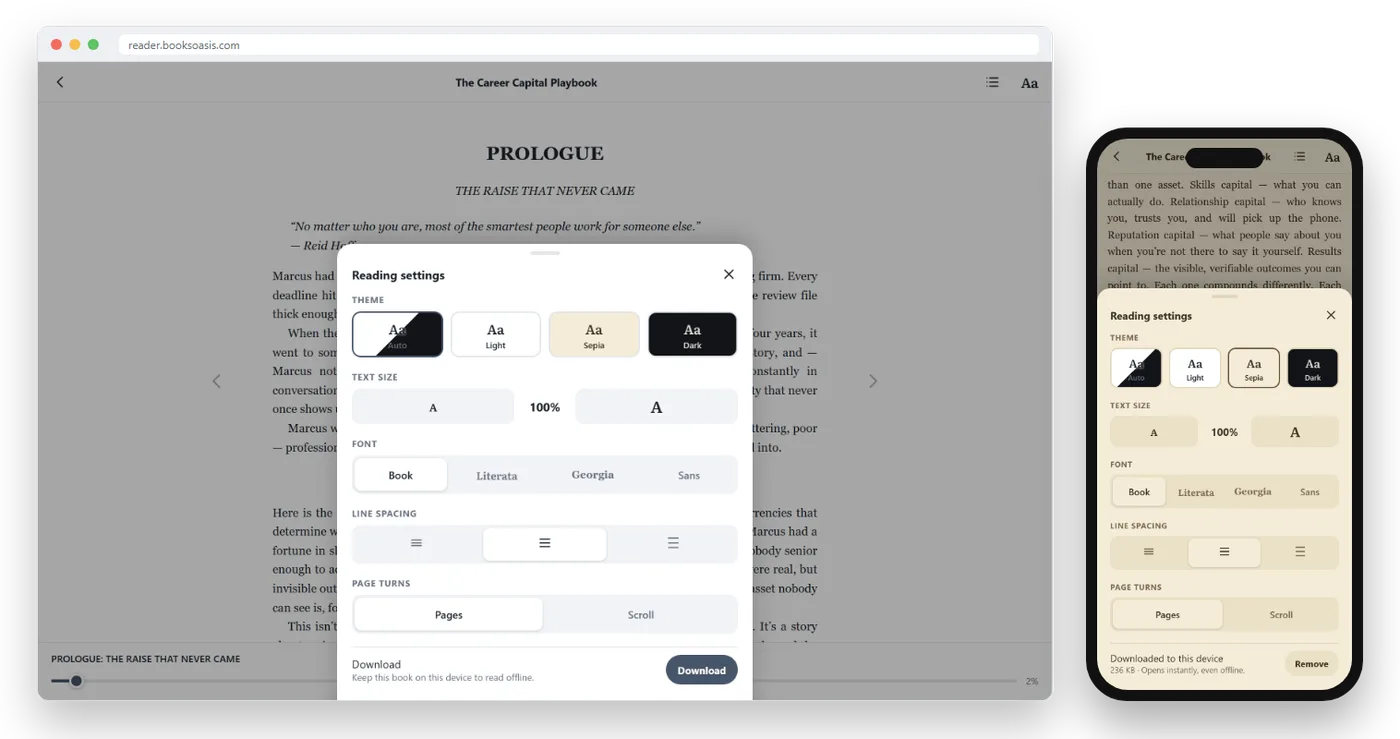
Oasis Reader opens in any modern browser and can be added to your home screen like an app. You can download books to read offline, choose Light, Sepia or Dark themes, highlight in four colors, add notes, and pick up on another device exactly where you stopped.
BooksOasis in one box
- A second store beside your Kindle or Kobo, for reading on your phone, tablet or computer.
- Books sold direct by independent publishers, who keep the full ebook price.
- No subscription: daily deals, weekly offers and series discounts instead.
What it doesn't do: it doesn't send books to Kindle or Kobo e-readers, and ebooks aren't downloadable files.
See today's offersWhich should you choose?
| If you... | Choose |
|---|---|
| Read lots of independent genre fiction | Kindle, for Kindle Unlimited |
| Borrow a lot from your library, especially outside the US | Kobo |
| Buy books from many places, including DRM-free files | Kobo |
| Want the cheapest e-reader | Kindle, on sale |
| Mostly read on your phone or laptop | A phone-first store such as BooksOasis, Apple Books or Google Play Books |
| Want to support independent publishers and catch deals | Add BooksOasis alongside either |
Kindle and Kobo outside the US
Much of the Kindle vs Kobo debate is written from an American point of view. Where you live can change the answer.
- Store availability. Both sell in many countries, but catalogs and prices differ from one country to the next.
- Library borrowing. Kobo's built-in OverDrive borrowing works in many countries; Kindle's library support through Libby is mainly a US feature.
- Subscriptions. Kindle Unlimited and Kobo Plus are offered in some countries and not others, at different prices.
- Device prices. Sales and availability of e-readers vary a lot by region.
If you live outside the US, check your own country's store for both before deciding. Library borrowing in particular often tips the balance toward Kobo.
Who should skip both
An e-reader is a lovely thing, but it isn't for everyone. You may be better off without either if:
- You read in short bursts. A few pages on a bus or in a queue happen on the phone already in your pocket.
- You read on a laptop for work or study. A browser-based reader keeps your book next to your other tabs.
- You read a book or two a month. The device costs more than a year of books.
- You share devices at home. A reader that works on any screen with a sign-in is easier to share than one e-reader.
If that sounds like you, read do you need an e-reader? before buying one.
Can you use both?
Yes, and many readers do. There is no rule that you must pick one store. A common setup is an e-reader from one brand for most reading, the other brand's app on your phone for books only it sells, and a library app for free borrowing.
The only thing you can't do is merge the libraries. Each store's books stay in that store's apps.
Switching from one to the other
If you are moving from Kindle to Kobo, or the other way, keep these points in mind:
- Your old library stays put.Keep the old store's free app on your phone to read what you already own.
- Don't rebuy everything.Rebuy only the few books you re-read often, and only when they are on offer.
- Move your reading lists.Wishlists and series you follow need to be recreated in the new store.
- Set up library borrowing.On Kobo, sign in to OverDrive on the device; on Kindle in the US, link Libby.
Popular with BooksOasis readers
No e-reader needed for any of these.
Mistakes to avoid when choosing
- Choosing on device price alone. The cheaper e-reader ties you to a store for years; pick the ecosystem first.
- Assuming you can move books later. You can't move protected books between Kindle and Kobo.
- Subscribing by default. Only subscribe if you read enough from the catalog to beat buying on offer.
- Forgetting the library. Free borrowing can matter more than any feature, so check how each works where you live.
The verdict
Kindle is the safe, big-store choice with the best subscription for heavy genre readers. Kobo is the open, library-friendly choice that respects your files. Both are excellent.
If you don't want to buy a device at all, or you want your money to go further toward independent authors, read on the screens you already own and keep a store like BooksOasis alongside whichever e-reader, if any, you choose.
Questions
Is Kobo better than Kindle?
Kobo is better for library borrowing on the device and for opening EPUB files from other sources. Kindle is better for catalog size and Kindle Unlimited. Both make excellent e-readers.
Can a Kobo read Kindle books?
No. Kindle books are protected to open only in Kindle apps and devices.
Which is cheaper, Kindle or Kobo?
Kindle devices are often cheaper, especially on sale. Book prices vary title by title, so compare the books you actually read.
Can I borrow library books on Kindle?
In the US, Libby can send many library ebooks to a Kindle. Kobo e-readers borrow through OverDrive directly on the device in many countries.
Where does BooksOasis fit if I own a Kindle or Kobo?
BooksOasis is for reading on phones, tablets and computers. It doesn't send books to Kindle or Kobo e-readers, so it works best as a second store alongside your e-reader.
Which lasts longer on a charge, Kindle or Kobo?
Both e-ink ranges typically last weeks on a charge with normal use. Battery life depends more on screen brightness, Wi-Fi use and how much you read than on the brand.
Try reading on the screen you already own
No device to buy. Open an ebook in seconds on your phone, tablet or computer.